Rebuilding Sexual Confidence After Menopause: Expert Q&A
With Kate Moyle (Psychosexual & Relationship Therapist), Dr Angela Wright (GP & Clinical Sexologist) and Dr Pavan Minhas (Consultant Gynaecologist)
When your sex life shifts
Let's be honest: the conversation around sex in menopause has, for too long, been almost non-existent. Women are handed a prescription or a pamphlet and left to quietly navigate one of the most significant shifts their bodies will ever experience — often alone, often in silence, and often with the mistaken belief that their pleasure is no longer a priority.
It isn't. And it never was.
At NAYDAYA, we believe your body deserves to be spoken about openly — including what makes it feel good. So we brought together three leading experts to answer the questions many women are afraid to ask: about self-pleasure, sexual confidence, lube for menopause, and the changes that are entirely normal — but nobody tells you about.
First, what's actually happening to your body?
Before we can talk about rebuilding confidence, it helps to understand why sex in menopause can feel so different. As oestrogen levels decline, the vaginal tissues become thinner, less elastic, and less naturally lubricated. This is known as genitourinary syndrome of menopause (GSM) — and it affects up to 50% of women in menopause, though many never report it to a doctor.
Symptoms can include:
- Vaginal dryness and a burning or stinging sensation
- Discomfort or pain during sex (dyspareunia)
- Reduced sensitivity and difficulty reaching orgasm
- Lowered libido and decreased arousal
The critical thing to understand? These are physiological changes — not a reflection of your desirability, your relationship, or your femininity. They are biology. And biology can be supported.
"How can women rebuild their sexual confidence?" — Kate Moyle, Sex & Relationship Therapist
Kate Moyle is one of the UK's most trusted voices in sexual health and therapy, and she works with women every day who feel disconnected from their bodies after menopause. Her perspective on rebuilding sexual confidence is both practical and deeply compassionate.
"Start by separating your body from your narrative. Menopause coincides with a cultural moment — midlife — when women have often absorbed decades of messaging that their value is tied to youth and fertility. Rebuilding sexual confidence means challenging that story. Your body is not broken. It is evolving.
Reframe what pleasure means to you. Many women discover, in menopause and beyond, that their experience of pleasure actually deepens. Without the pressures of contraception, fertility, or young children, there is often more space for genuine intimacy and self-exploration. I'd encourage exploring this time with curiosity rather than grief.
Go slowly — and use lubrication. One of the most common reasons women stop self-pleasure during menopause is because it's become uncomfortable. This creates a cycle: discomfort leads to avoidance, which leads to further tissue thinning and reduced sensitivity, which makes discomfort worse. Breaking that cycle often starts with the right lube for menopause — something that makes the experience feel pleasurable again, not something to get through.
Talk about it. Whether with a partner, a therapist, or a trusted friend — bringing these experiences out of isolation is one of the most powerful things a woman can do. Shame thrives in silence. Confidence is built in connection."
"Sexual confidence isn't about how your body looks — it's about how connected you feel to it. That connection can absolutely be rebuilt." - Kate Moyle

"What do you look for in a lube?" — Dr Pavan Minhas, Consultant Gynaecologist
Dr Pavan Minhas works closely with women navigating menopause, and the question of lubrication comes up in almost every consultation about intimate health. So what should women actually be looking for?
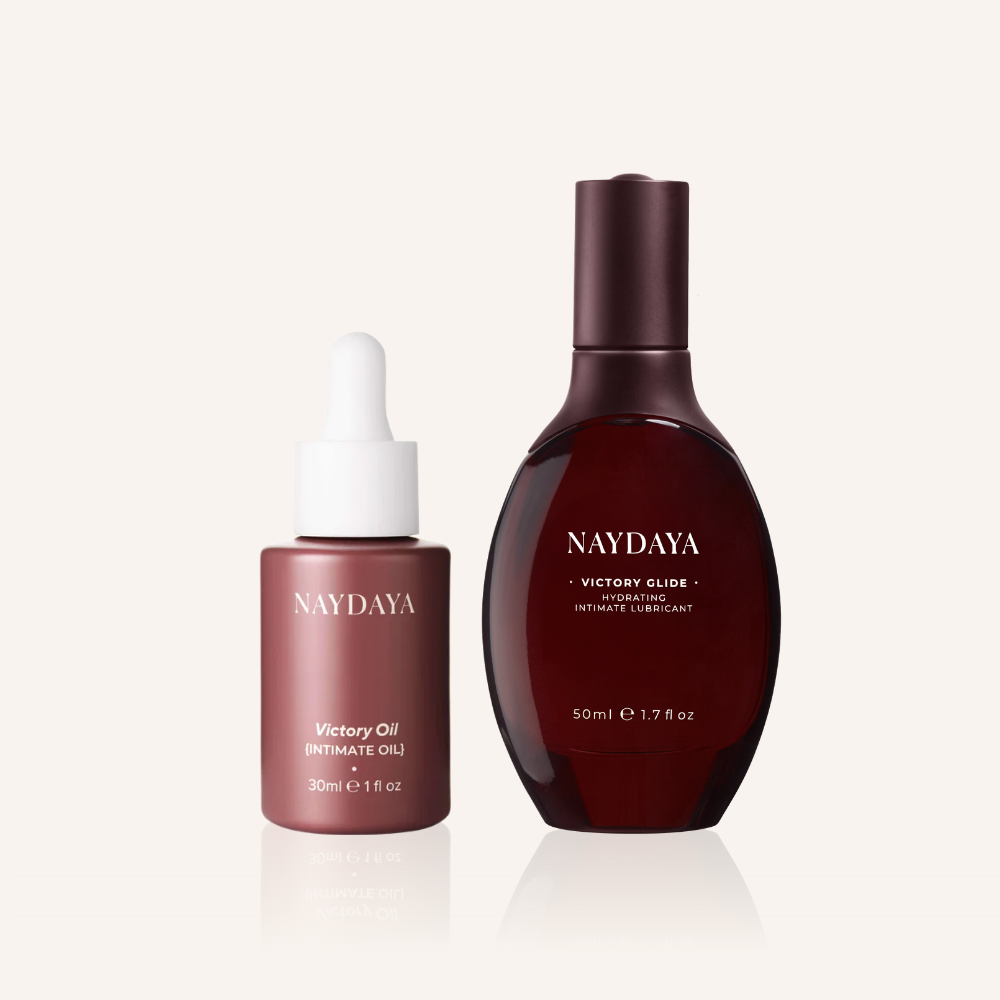
"Formulation matters. Many over-the-counter lubricants contain glycerine, parabens, or artificial fragrances that can disrupt the vaginal microbiome and exacerbate irritation — the opposite of what's needed. NAYDAYA's Victory Glide is a natural, pH-balanced formula that supports rather than interferes with vaginal health.
Texture and longevity. A good lube for menopause should last — not require constant reapplication — and should feel genuinely comfortable rather than sticky, tacky, or synthetic.
Ingredients you can trust. I look for lubricants with skin-nourishing ingredients — ones that don't just reduce friction but actively support tissue health. Vitamin E, natural oils, and botanical extracts can all play a supportive role in soothing and moisturising sensitive intimate skin.
The right product for the right moment. There's an important distinction between a lubricant used during sex or self-pleasure, and a daily vaginal moisturiser used for ongoing tissue health. Both have a role to play. For intimacy, I recommend something that enhances the experience — not just manages symptoms."

"Would you prescribe self-pleasure?" — Dr Angela Wright, GP & Women's Health Specialist
We asked Dr Angela Wright the question that many women quietly wonder but rarely voice: would she actually recommend self-pleasure as part of a woman's health toolkit?
Her answer was clear — and empowering.
"Self-pleasure isn't just a source of enjoyment; it's a genuinely valuable way to maintain vaginal health during and after menopause. Regular sexual stimulation — with or without a partner — increases blood flow to the vaginal tissues, helps maintain elasticity, and supports natural lubrication. From a medical perspective, staying sexually active (in whatever form that takes) is one of the most practical things a woman can do to maintain her intimate health."

Dr Wright also notes the importance of using the right products to support this. Vaginal dryness can make self-pleasure uncomfortable if not impossible — which is precisely why lube for menopause isn't a luxury. It's a tool for maintaining your wellbeing.
"There's nothing to be embarrassed about. Self-pleasure is a completely healthy, normal part of being a woman — at every age."
Introducing Victory Glide: Lube for Menopause, Formulated with Women's Health in Mind
This is where Victory Glide comes in.

Victory Glide by NAYDAYA is a natural intimate lubricant designed specifically for the needs of women navigating menopause, perimenopause, and postpartum recovery — those moments when the body needs more support than the standard options offer.
Formulated with 100% natural ingredients, Victory Glide is:
- Free from glycerine, parabens, and artificial fragrances — nothing that will disrupt your vaginal microbiome or cause irritation
- pH-balanced to work in harmony with the body's own environment
- Enriched with skin-nourishing botanicals including antioxidant oils and Vitamin E to soothe, moisturise, and support intimate skin health
- Long-lasting and silky in texture — made to enhance pleasure, not just reduce friction
- Designed for self-pleasure and partnered sex alike — because your pleasure is always valid
Victory Glide isn't a workaround for menopause. It's a solution that lets you reclaim the experience of intimacy on your own terms — comfortably, confidently, and without compromise.
The Questions Women Ask (But Often Don't Say Out Loud)
Is it normal to lose interest in sex during menopause?
Yes. Hormonal shifts — particularly the decline in oestrogen and, in some women, testosterone — directly affect libido. Add in sleep disruption, mood changes, and the discomfort of vaginal dryness, and it's entirely understandable that sex becomes less appealing. But low libido is not inevitable, and it is not permanent. Addressing the physical symptoms (including using lube for menopause) and exploring your relationship with your body can make a significant difference.
Will sex ever feel the same as it did before?
It may feel different — but different doesn't mean worse. Many women describe their experience of intimacy after menopause as more intentional, more connected, and more on their own terms. The key is giving your body what it needs: patience, the right products, and permission to explore.
Is self-pleasure really okay to talk to my doctor about?
Absolutely. Practitioners like Dr Angela Wright and Dr Pavan Minhas want to have these conversations. Self-pleasure is a legitimate aspect of women's health — and one that's directly relevant to managing menopausal symptoms. If your doctor makes you feel otherwise, consider seeking a specialist with expertise in women's health or menopause.
Can lubricant really make that much difference?
Ask any woman who has tried a quality, natural lube for menopause — the answer is almost always yes. The right lubricant doesn't just make sex more comfortable; it can make it genuinely pleasurable again. That shift has a ripple effect on confidence, body image, and the willingness to keep exploring.
A Note on Language
At NAYDAYA, we believe that being able to talk about your vagina openly is part of taking care of it. Shame has never improved anyone's health. So we'll keep saying the words — vaginal dryness, self-pleasure, vulva, orgasm — because they are normal, and because the women reading this deserve to feel that they are too.
Sex in menopause is not a chapter that's closing. For many women, it's one that's just beginning — with more self-knowledge, more honesty, and more permission than ever before.
You deserve to feel incredible in your body. At every stage.
This article features expert perspectives shared via video by Kate Moyle (Psychosexual & Relationship Therapist), Dr Angela Wright (GP & Women's Health Specialist), and Dr Pavan Minhas (Consultant Gynaecologist). All content is for informational purposes only and does not constitute medical advice. Please consult your GP or a menopause specialist if you have concerns about your symptoms.